
When you are scared, your brain scans for what could go wrong. That is its job. If everything has felt hard for a long time, it gets very good at that job, and the list of what could go wrong gets long.
There is an easy way to give that scan something else to find. It takes a mug and some scrap paper.
Watch the full video:
Why gratitude gets an eye roll
Say “gratitude” and most people picture a guru and a blank journal. Then comes the part you dread: a daily writing assignment you will forget by Wednesday.
I am not going to make you do anything. I am going to show you a version with no schedule, no blank page, and no homework.
It has been around a long time
Seneca wrote a whole book about giving thanks, On Benefits, about 2,000 years ago. Cicero is quoted calling gratitude the parent of all other virtues. Harvest festivals thanked the gods for the season. Most religions still have a practice of giving thanks.
Many cultures landed on the same habit. That is worth noticing.
What researchers have found
The research exists, and it is modest. I want to say that plainly.
In 2003, Emmons and McCullough had people list what they were grateful for each week. They reported more satisfaction with life, more exercise, and fewer physical complaints. A 2023 review linked gratitude practices to fewer symptoms of anxiety and depression, though many of those trials were small.
In 2017, Karns and colleagues had healthy adults do three weeks of gratitude writing. Activity changed in a brain area tied to reward. Small studies, so I will say “researchers have found” and leave it there.
Related: DTMM: Showing Gratitude
https://www.youtube.com/watch?v=Ck95QP9Q3WQ
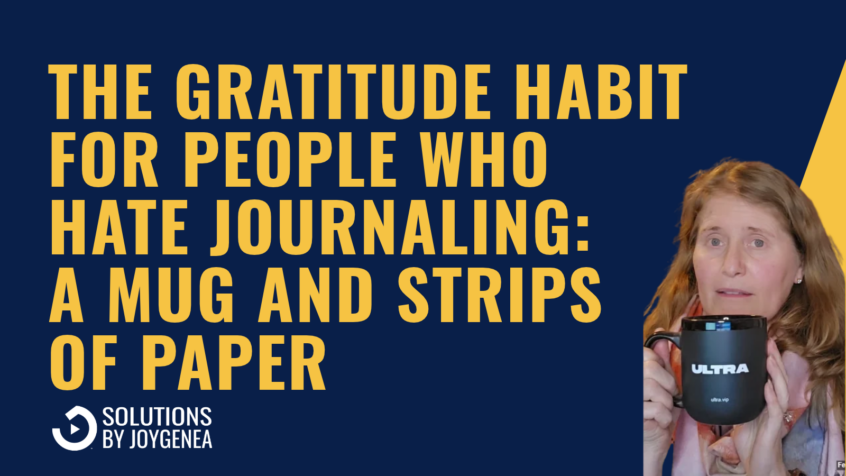
The mug
A few years ago I got a mug. It represents some incredible training I did over several years, and it was just sitting on my desk. So I put it to work.
Here is the whole system:
- Cut scrap paper into strips. I used a paper cutter.
- Keep the strips and a pen next to your desk, with the mug.
- When something goes well, grab a strip right then.
- Write “Thank you” and what happened. Or thank the person who went above and beyond.
- Fold it and drop it in the mug.
- If it involves someone, text them. A couple of people got a photo of my slip.
- Once a month, empty the mug and start over.
I love watching it fill up. And I have noticed something. It has been training my brain to notice things worth being thankful for, in the moment.
When someone texts or sends a voice message back later, you get a second hit of reward. It is not complicated.
When fear takes over
If you have been stuck in fear or anxiety, you can use the same strips for a different job. Step back and write one line: “Here is how this could go incredibly right for me.”
Then watch what your brain does with that. It is a small way to stop staring at “this could all go wrong.”
Related: DTMM: Optimism and Fear
https://www.youtube.com/watch?v=xxwafht1jvw
For more on building a habit that does not depend on executive function alone, read Starting A New Routine or Habit, Neurodiverse and Different Thinker Style. I also wrote about showing gratitude and optimism and fear before.
What went right for you in the last 24 hours, even something small? Write it on a scrap of paper tonight, name who helped, and send them a text.
JoyGenea Schumer
International Neurodiversity Success Coach & Speaker
Introduction to the AI Prompt
You have probably tried a planner, a journal, or an app that was never built for your brain. This week’s blog shows a gratitude habit with no blank page and no schedule, only a mug and a few strips of paper. The prompt below turns that idea into a focused 10 to 15 minute session about what is going right in your own life. It asks one question at a time, so it will not feel like homework. Copy the prompt below, paste it into your AI tool of choice, and give it 10 to 15 minutes.
Custom AI Prompt
You are my direct, kind, peer-level thinking partner. You understand dyslexia and neurodiversity. You are not a therapist and not a cheerleader.
This is a focused 10 to 15 minute session. Ask me one question at a time. Keep your replies short, in plain sentences that are easy to scan, so I never feel overwhelmed.
Here is the framework: when things have felt hard for a long time, my brain scans for what could go wrong. I want to give it something else to find. The method is simple. When something goes right, I catch it in the moment, write one thank you on a strip of paper, and tell the person who helped. I do not want a blank page or a daily streak.
Ask me these, one at a time, going deeper each time:
- What went right for me in the last 24 hours, even something small?
- At work or school, what keeps going right that I skip past without noticing?
- Who helped with it, and what would it look like to tell that person in one sentence?
- When fear shows up, what is the first “this could all go wrong” thought, and what is the version where it goes incredibly right?
- What gets in the way of catching a win in the moment, and what is the smallest way around it?
When I have answered all five, name the one pattern you noticed in my answers. Then give me one small, concrete action to take before the end of today.
Video Transcription:
Today’s topic probably won’t surprise you considering what week I’m filming this, and roll with it. You’re gonna like it. Do you know an easy way to shift your neurology from fear to growth? It’s that simple. I do. Making gratitude an easy thing and an easy habit to have, that’s actually the s- there’s your answer right there, and here’s why.
By the way, I’m JoyGenea. I coach extremely successful unconventional leaders, and I also work with clients internationally that have ADHD, dyslexia, and/or autism, quite often a variety of all of that. And why I bring this up today is because so often we forget simple and easy ways that we can actually shift our brain chemistry and can be happier and in more of a state of happiness.
And that’s what I wanna talk about today because you deserve to be in that state a lot more, and it might be a whole lot easier than you think. So giving thanks has deep roots in history. That’s why I bring it up. Often people, when they hear this, they think, “Oh, this is very guru-y, and right now only, and oh, you’re gonna make me journal.”
I’m not gonna make you do anything. What I am gonna tell you is that it has been around for thousands of years. Tribes were doing it years ago. The Egyptians were doing it thousands of years ago. The Greeks and the Romans had traditions, ceremonies, and so forth, all giving thanks to many things in many ways.
And m- most recently, obviously, religions all have practices about giving thanks and having gratitude. My point being, if it’s a practice that has been around that long, we should probably take a hint from multiple cultures, from multiple religions, from multiple walks of life types of things, that maybe it’s a really good practice that we should be doing today, and I find a lot of people aren’t, and it can be so easy.
So science, of course, came in and said, “Hey, wait, we wanna quantify this, and we wanna add some value to it and show, validate it, show that type of thing.” Great. In 2003, there was a study by Emmons and McCullen, I apologize if I said that wrong people that took the time to acknowledge, give thanks, and gratitude in a journal slept better were typically in a better mood.
And when asked about life satisfaction, they actually said they were more satisfied with their lives Now, if that’s not enough, the brain researchers came in, little bit, little dash more of some more science. In 2008, the researchers by Zane said gratitude related to judgment lit up the right anterior superior temporal cortex.
Basically, that’s the area where we’re– we judge other people. We assess where we fit in society and social behaviors. It also lit up the reward regions of the brain. So there’s a little bit of the science of gratitude. I’m all about making things simple, easy, manageable, with a high reward.
So here’s an option that might be appealing to you. Expand on it. Few months ago, I got this beautiful mug. Love this mug. This mug represents something really cool, an amazing experience that I had over multiple years, some incredible training. And it was just sitting on a desk, right? With the… I took…
This is now full, and I actually empty it every month. But I took strips of paper and just ripped them apart, this I used my paper cutter, and made little strips of paper that sit next to my desk, actually. And every time something happens in real time that I go, “Oh, my gosh, I’m so grateful for that. Wow, did that work out.
That’s awesome,” I literally take out my sheet of paper and write on there, “Thank you. This incredible thing just happened, and I’m so grateful.” Or, “Thank you to for going above and beyond.” And that might cause me to write them an actual thank you or to send them a text, or a couple people have actually received a photograph of my s- my little slip that I then fold up and toss into my mug.
So I’m just, I’ve just started a little simple gratitude mug, and I love watching it fill up, and I really enjoy tossing out the papers when it’s all done and filling it back up again. And I’ve noticed that it was simple and easy, and it a, has been training my brain in a new habit of noticing grati- noticing things to have gratitude about, to be thankful about in the moment.
So I’m receiving those rewards in the moment. And then if they involve other people and I include them in that, I find when they text me back later, when they have time to send me a voice message back later, I get another hit of dopamine and powerful endorphins. It’s really nice, and it’s not complicated So if you’ve ever thought about a gratitude journal or thankfulness and where that possibly fits, and maybe you’re working on shifting out of some more toxic energy, maybe a lot of fear, maybe a lot of anxiety, this can be a great way to help you not be so hyper-focused on the fears and the anxieties and how, “Oh my goodness, this could all go wrong.”
Instead, take a moment, step back, and maybe write out, “Here’s a way this could go incredibly right for me. Wouldn’t that be great?” Or when… Or identifying those moments when, “Oh my goodness, this went so well. I’m so grateful.” One thing I’m really grateful for is being able to help people figure out how their brain works, how their chemistry was created, and how they’re, how they work in the world.
Basically building up their manual of who they are, because once they know that, once they see that and feel that, I watch them expand into their space and their skin. The confidence just grows, and they become able to do those things they’ve been dreaming about way in the back of their mind, or to have those goals.
Th- they’re, they just achieve them so much easier because they believe in themselves and they have that confidence. This little practice can help you on that journey. I’m JoyGenea, unconventional leadership coach, international neurodiversity coach, and champion for all of the amazing people out there in this world doing fabulous things.
Thank you so much. And if you love this, follow me. If you thought this was great, share it with somebody else. And go out and get yourself your own mug and a few sheets of paper. And remember, you can just do it right in the moment.